







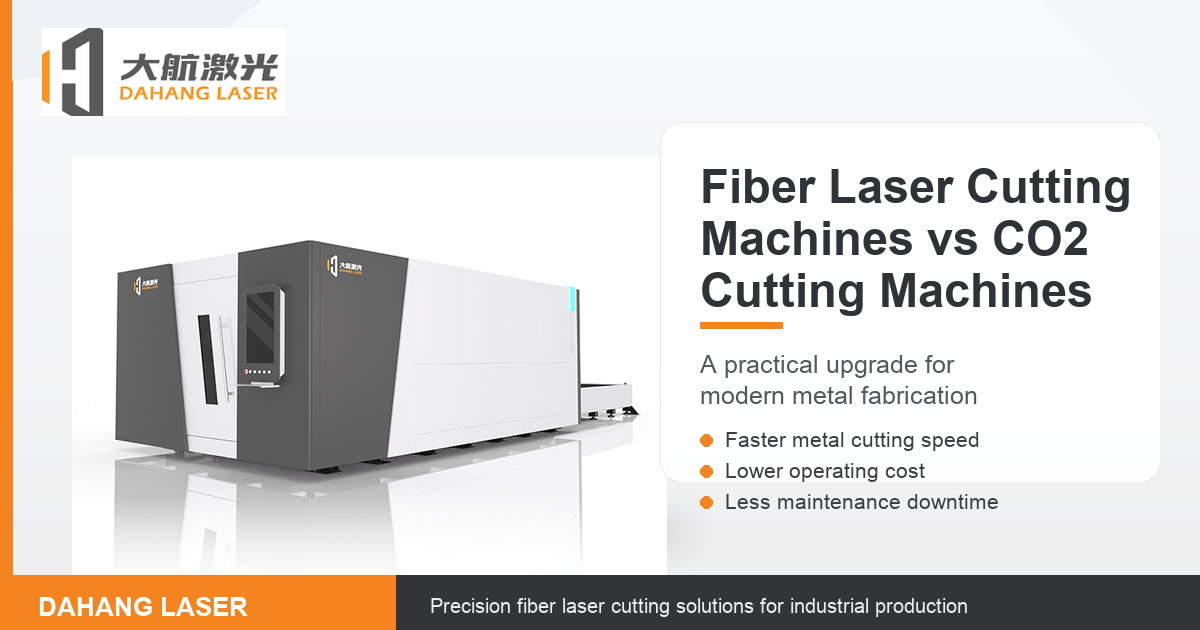
When manufacturers compare laser cutting equipment, two options are mentioned again and again: fiber laser cutting machines and CO2 laser cutting machines. Both technologies can produce clean, accurate cuts, but they are not equally suited to every production environment. For metal fabrication, sheet metal processing, machinery parts, electrical cabinets, advertising signs, and many high-volume industrial applications, fiber laser cutting machines have become the more efficient and cost-effective choice.
This article explains the main advantages of fiber laser cutting machines compared with CO2 cutting machines, and helps buyers understand when upgrading to fiber laser technology makes practical business sense.
I. Higher Efficiency for Metal Cutting
The most obvious advantage of a fiber laser cutting machine is its cutting efficiency on metal materials. Fiber lasers generate a shorter wavelength than CO2 lasers, allowing the beam to be absorbed more effectively by metals such as stainless steel, carbon steel, galvanized sheet, aluminum alloy, brass, and copper.
Because of this higher absorption rate, fiber laser cutting machines usually achieve faster cutting speeds, especially on thin and medium-thickness metal sheets. For workshops that process large volumes of metal parts every day, this speed advantage can directly increase output, shorten delivery time, and improve overall production capacity.
II. Lower Operating Costs
Operating cost is one of the key reasons many manufacturers choose fiber laser systems. A fiber laser cutting machine has a high photoelectric conversion efficiency, which means more of the input electrical energy is converted into useful laser energy. Compared with traditional CO2 laser cutting machines, fiber laser equipment generally consumes less electricity during operation.
In addition, fiber laser systems do not require the same level of laser gas consumption and optical path maintenance associated with CO2 systems. Over time, lower energy use, fewer consumables, and reduced maintenance needs can make fiber laser cutting a more economical solution for metal processing factories.
III. Less Maintenance and More Stable Operation
CO2 laser cutting machines rely on a more complex optical path that often includes mirrors, lenses, gas systems, and alignment work. These components need regular inspection and adjustment to maintain cutting quality. If the optical path is misaligned, cutting accuracy and edge quality may be affected.
Fiber laser cutting machines use fiber transmission, which provides a more stable beam path and reduces the need for frequent optical adjustment. The structure is simpler, maintenance is easier, and downtime can be reduced. For companies that need continuous production, this stability is a major advantage.
IV. Better Performance on Reflective Metals
Traditional CO2 laser cutting machines can face challenges when cutting highly reflective metals such as aluminum, brass, and copper. Reflection may reduce cutting efficiency and increase the risk of equipment issues.
Fiber laser cutting machines are more suitable for many reflective metal applications. With the right machine configuration and process parameters, they can cut aluminum alloy, brass, copper, and other materials more efficiently. This gives manufacturers more flexibility when handling different customer orders.
V. Compact Structure and Easier Integration
Fiber laser sources are usually more compact than CO2 laser systems. A fiber laser cutting machine often takes up less space and can be integrated more easily into modern production lines. For factories with limited floor space, this compact design can be very practical.
The equipment can also be combined with automatic loading and unloading systems, nesting software, and intelligent cutting controls. This helps factories move toward more automated, efficient, and standardized production.
VI. High Cutting Precision and Clean Edges
Precision is one of the core advantages of laser cutting. Fiber laser cutting machines provide a focused beam with high energy density, which helps achieve narrow kerf width, smooth cutting edges, and small heat-affected zones.
For sheet metal parts that require accurate dimensions and clean appearance, fiber laser cutting can reduce the need for secondary processing. This is especially valuable in industries such as machinery manufacturing, automotive parts, elevator production, electrical enclosures, kitchen equipment, and precision metal fabrication.
VII. Faster Return on Investment
The initial investment in a fiber laser cutting machine can vary depending on power, table size, brand, configuration, and automation level. However, for many metalworking companies, the higher processing speed and lower operating cost can support a faster return on investment.
When a factory cuts metal sheets frequently, even small improvements in speed, power consumption, and maintenance time can become significant over months and years. This makes fiber laser technology a strong choice for businesses focused on long-term productivity.
VIII. When CO2 Cutting Machines Still Make Sense
It is important to choose equipment according to the material and application. CO2 laser cutting machines still have advantages for some non-metal materials, such as acrylic, wood, leather, fabric, paper, and certain plastics. If a company mainly processes these non-metal materials, a CO2 laser may still be an appropriate option.
However, for metal cutting, especially stainless steel, carbon steel, aluminum, brass, and other industrial sheet metals, fiber laser cutting machines usually offer better speed, efficiency, stability, and cost performance.
Conclusion
Compared with CO2 cutting machines, fiber laser cutting machines offer clear advantages in metal processing: faster cutting speed, lower operating cost, reduced maintenance, better performance on reflective metals, compact structure, high precision, and stronger long-term productivity.
For manufacturers planning to improve efficiency, reduce production cost, and expand metal cutting capability, a fiber laser cutting machine is often the more competitive solution. Dahang Laser provides professional laser cutting equipment and application support for different industries, helping customers choose suitable machine configurations based on material type, thickness, production volume, and budget.