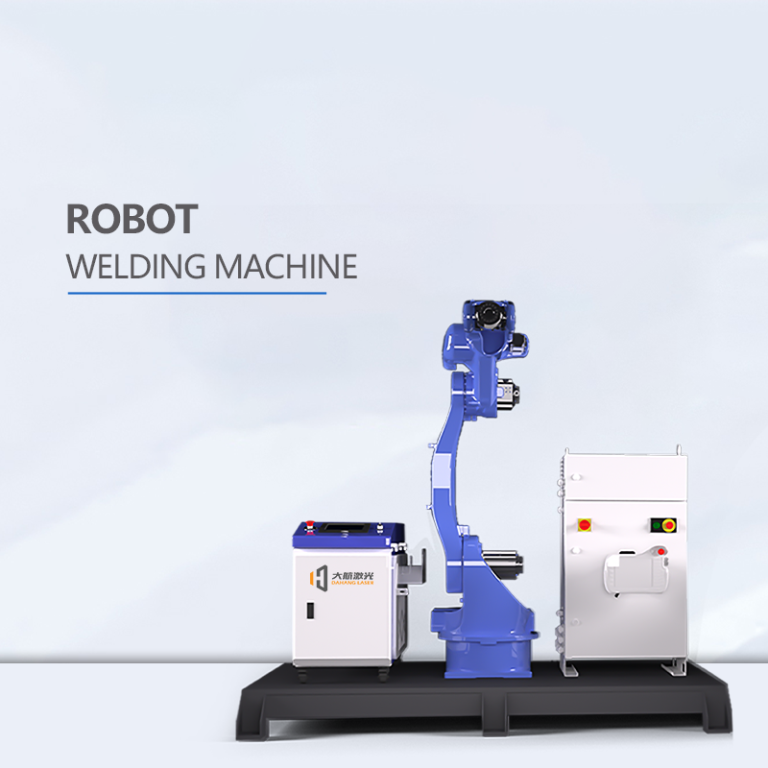
In today’s rapidly evolving industrial landscape, laser welding robots are emerging as indispensable assets, transforming manufacturing through unparalleled performance and versatility. This analysis explores their cross-sector applications and distinctive advantages, revealing how they drive intelligent, high-efficiency production.
I. Transformative Applications
• Automotive: Dual Guarantee of Speed & Quality
Meeting the industry’s extreme demands for throughput and precision, laser robots excel in joining high-strength steels and aluminum alloys—from body frames to engine components. Their high-speed, low-heat-input welding minimizes thermal distortion while enhancing structural integrity. Automated operation ensures consistent quality across high-volume production.
• Aerospace: The Precision Benchmark
Where micron-level accuracy and reliability are non-negotiable, laser robots manufacture airframe sections, wing assemblies, and turbine blades with unmatched consistency. Their controlled energy input prevents crack propagation and thermally induced deformations, guaranteeing component longevity under extreme operational stresses.
• Electronics: Micro-Joining Mastery
Laser robots perform flawless welds on minute components—from smartphone chip leads to micro-circuitry—ensuring electrical continuity and mechanical stability. Non-contact welding preserves delicate part integrity, meeting stringent reliability standards for SMT components and miniaturized assemblies.
• General Manufacturing: Versatile Fabrication Power
Adapting seamlessly to diverse production scenarios, these robots weld gears, shafts, flanges, and pressure vessels across materials including titanium alloys and stainless steel. They deliver superior weld quality while accelerating throughput in custom machinery, pipeline systems, and industrial equipment fabrication.
II. Competitive Advantages
• Surgical Precision & Superior Welds
Advanced optics and control systems enable micron-accurate beam placement. Concentrated energy creates deep-penetration, low-porosity joints with superior metallurgical bonding—enhancing fatigue resistance while eliminating post-weld processing.
• Unmatched Productivity & Cost Efficiency
Automated 24/7 operation with welding speeds 3-5x faster than manual methods slashes cycle times. Minimal heat input reduces distortion-related rework, while eliminating filler materials cuts consumable costs by 40-60%.
• Agile Adaptability
Rapid reprogramming handles design changes instantly. One system welds diverse geometries—from complex contours to variable material thicknesses—without retooling. Ideal for high-mix, low-volume production.
• Eco-Safe Operation
Fume-free, consumable-free process eliminates hazardous byproducts. Fully enclosed work cells with automated safety protocols protect operators from radiation and particulate exposure.
• Industry 4.0 Readiness
Integrated AI vision systems and IoT connectivity enable real-time seam tracking, adaptive parameter adjustment, and predictive maintenance. Seamless MES/PLC integration creates future-proof smart factories.
III. Conclusion: Forging the Smart Manufacturing Era
Laser welding robots are redefining industrial production—delivering unprecedented quality, agility, and efficiency while driving sustainable manufacturing. Their continuous evolution promises further breakthroughs in speed, intelligence, and material capabilities. For forward-thinking enterprises, adopting this technology isn’t merely an upgrade; it’s the critical path to competitive dominance in the age of digital manufacturing.